

In industrial processes that handle gases carrying solid particles, particulate control is an important step to maintain operational stability, protect equipment and meet environmental requirements. In many industrial sectors, one of the most widely used solutions for this purpose is the industrial cyclone.
A cyclone is a mechanical separation device designed to remove solid particles from gas streams through the action of centrifugal force. It is a well-established technology, widely applied in gas treatment systems, dust pre-separation and particle recovery in different production processes.
What is an industrial Cyclone
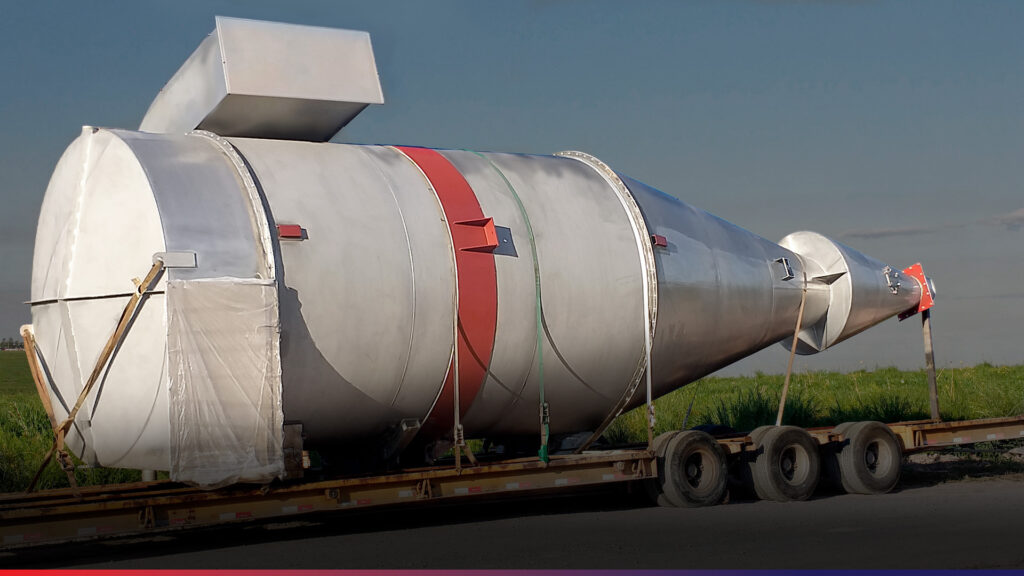
An industrial cyclone is a particle separator that uses the principle of centrifugal force to separate solids suspended in a gas flow. Unlike technologies that rely on filters or electrostatic systems, the cyclone operates exclusively through mechanical effect, without the need for filter elements.
Its basic structure consists of:
• Cylindrical or cylindrical-conical body
• Tangential gas inlet
• Separation chamber
• Lower cone for particle collection
• Upper outlet for gas with lower solid concentration
Separation working principle
The operation of an industrial cyclone is based on the difference in mass between the gas and the particles carried by it.
When the gas enters the cyclone, a descending vortex is formed, characterized by a helical movement along the inner wall of the equipment. In this process, solid particles, which have greater mass than the gas, are projected against the cyclone walls due to centrifugal force.
The separation process occurs in three main stages.
First, the particle-laden gas enters tangentially into the cyclone, generating rotational movement. This movement creates a centrifugal force field inside the equipment.
Next, the particles are thrown against the internal walls of the cyclone. Upon hitting this surface, they lose velocity and begin to move downward due to gravity.
Finally, the particles accumulate in the lower cone of the equipment, where they are collected or discharged to transport or storage systems.
Meanwhile, the gas, now with a lower concentration of particles, changes direction and forms a second vortex, this time ascending, which carries the flow to the upper outlet of the cyclone.
Variables that influence separation efficiency
The separation efficiency of an industrial cyclone depends on different factors related to equipment design and process characteristics.
Among the main parameters that influence cyclone performance are:
• Inlet gas velocity, higher velocities increase centrifugal force and favor separation, but may increase pressure drop.
• Cyclone diameter, smaller cyclones tend to generate higher centrifugal force intensity, favoring the separation of finer particles.
• Particle size distribution and density, larger and denser particles are more easily separated, while very fine particles may require additional stages.
• Internal geometry of the equipment, the shape of the body, cone and tangential inlet directly influences flow pattern and vortex stability.
Industrial applications of cyclones
Industrial cyclones are widely used as separation equipment in different stages of production processes. In many cases, they act as pre-separators before finer filtration systems.
Some common applications include:
• Dust removal in pneumatic conveying systems
• Particle separation in grinding and drying processes
• Gas treatment in industrial boilers and furnaces
• Recovery of particulate material in chemical processes
• Emission control in industrial processes
Advantages of cyclone technology
The use of industrial cyclones presents important advantages compared to other particle separation methods:
• Operation without filter elements
• Ability to operate in high-temperature environments
• Low maintenance cost
• Simple and reliable mechanical structure
• High durability in industrial environments
Separation equipment as part of process reliability
In industrial environments, proper particle separation is not only related to environmental concerns. Controlling particulate matter also helps reduce equipment wear, prevent residue buildup in pipelines and maintain proper operating conditions.
When properly sized and integrated into the process, the cyclone contributes to greater operational stability, protection of downstream equipment and better control of gas flow.
Rely on Ottani to evaluate the best solution for your process
If your operation needs to reduce particulate matter in gas flow, protect downstream equipment or structure a pre-separation stage before complementary systems, the next step is to evaluate process conditions and define the most suitable cyclone for your case.
Talk to a specialist, share information such as flow rate, temperature, type of particulate and removal objective, and request a technical analysis for specification, sizing and integration of the equipment into your plant.